How to Select the Right Trailer Axle
Share article
There are numerous things to consider when purchasing a replacement axle for your utility trailer or RV. Do you know the weight capacity of the trailer? Do you know how to measure for a replacement trailer axle and the different styles and orientations you can chose from? Are you in need of new hangers or leaf springs with the axle beam? Choosing the right axle can seem like a daunting task, but after reading the helpful tips outlined in this post, you will be able to purchase your trailer axle with confidence.
Trailer Axle Diagram & Definitions
To start, understanding the parts of a cargo trailer axle will help you during the buying process. Refer to the following diagram and definitions when purchasing axles and axle components.

- Axle beam: A rigid piece of steel that connects a set of wheels; the foundation of your trailer suspension system
- Lugs: The nuts that are used in conjunction with bolts to secure the wheel to the trailer axle
- Attaching parts: Used to bolt leaf springs to onto the hangers
- Hangers: Used to mount the leaf springs onto the trailer
- Leaf springs: Made of several layers of metal that are curved upward and clamped together to form an integral part of the trailer’s suspension system by helping to support the weight
- U-bolts: Used to keep the leaf springs on a trailer’s suspension system together
- Shackles: Allow the leaf spring to change lengths as the trailer travels over different types of terrain
- Equalizers: Connect to the leaf springs; they rock to absorb road shock and smooth out your ride
How to Measure a Trailer Axle
Knowing your axle measurements and understanding the different spring axle options will help you choose the right fit for your utility trailer. The easiest place to find the right replacement axle for your trailer is on the tag from the trailer manufacturer that can be found on the tongue or neck of the trailer. This tag should have the VIN number of the trailer and will also include weight capacities needed to make a replacement axle purchase. The axle itself should also have a tag that indicates all the necessary replacement purchase information.
If you didn’t purchase your trailer from a company or can’t find the tag, there are a few other ways to correctly measure for your axle replacement, which we've detailed below.
How to Measure Trailer Axle Length
The hub face is the distance from the outside of one hub to the outside of the hub on the opposite side of the axle. Spring center is measured from the center of the spring seat on one side of axle to the center of the spring seat on the other side of the axle. Axle lengths are notated using the hub face distance, a forward slash and the spring center distance. For example, an axle with a 58-inch hub face distance and a 46-inch spring center would be written as 58/46.

Common Trailer Bolt Patterns & How to Measure Them
The number of bolts or lugs per wheel and the diameter of the circle the bolts are arranged in make up a trailer wheel hub bolt pattern. To measure a 5-lug bolt pattern, pick a bolt and measure from the outside of the bolt. Then, skip a bolt and measure to the center of the next bolt. To measure a 4, 6 or 8-lug bolt pattern, measure center to center of two bolts directly across from one another. The bolt pattern is notated by the number of bolts on a wheel and the diameter of the circle they form. For example, a wheel with 5 bolt holes that forms a circle with a 4.5-inch diameter would have a 5 on 4.5" bolt pattern.


Trailer Axle Capacity
Knowing your trailer weight capacity helps you understand your towing limitations. A single axle is just that — an axle with one set of wheels. A tandem axle has two sets of wheels and is basically two single axles put together, assuming the capacities are the same on each axle.
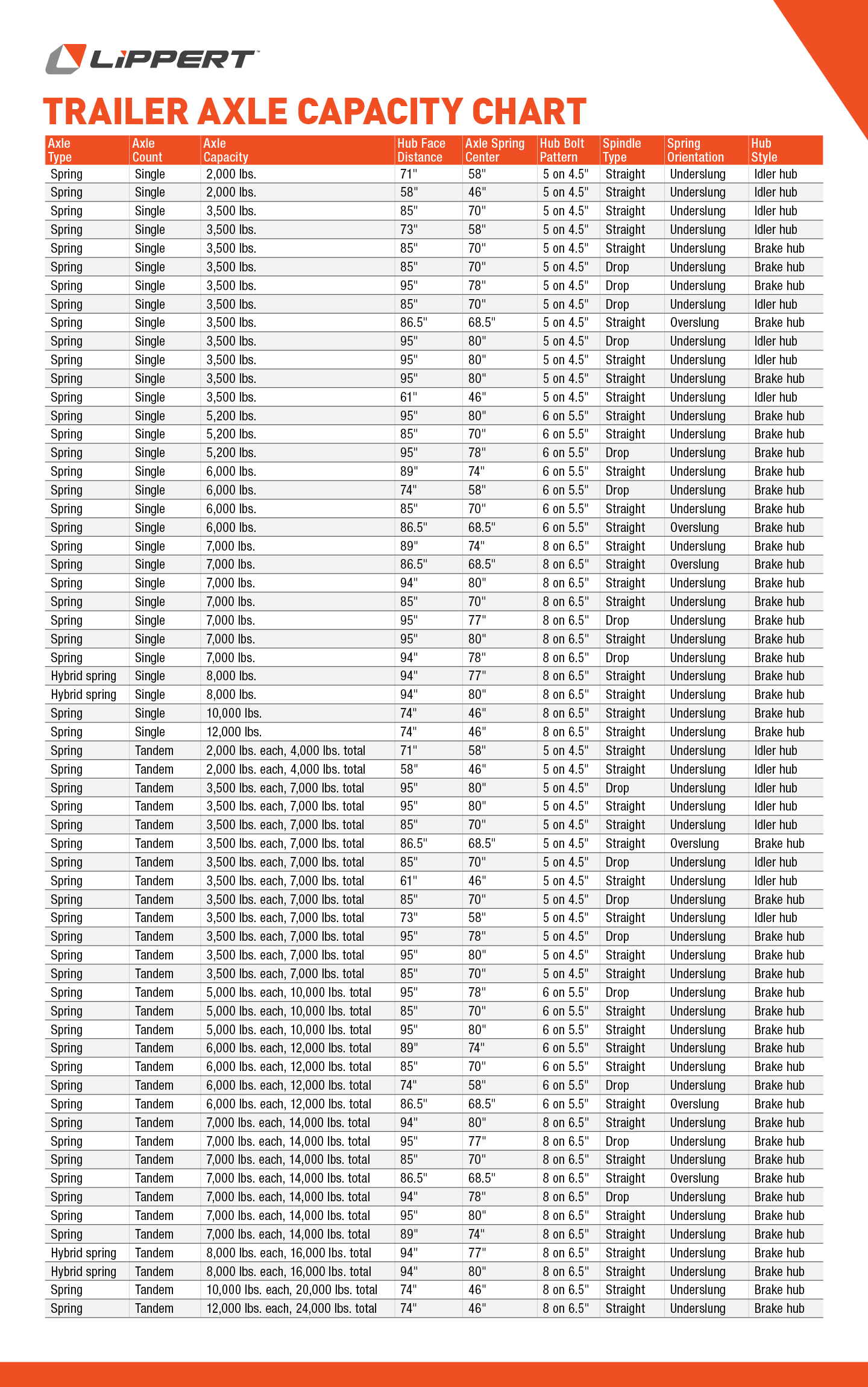
Refer to the trailer axle capacity chart below or download the printable PDF to see the different weight capacities between spring axles.

Trailer Axle Styles & Orientations
On the above trailer weight capacity chart, you may have noticed a few other axle options that are available, including spindle style, spring orientation and hub style. These are all a part of the buying decision, so we’ve defined each option below.
Spindle Style: Drop Spindle vs. Straight Spindle
Spindles provide a surface for your wheel bearings and wheel hub to rotate around. A straight axle has a completely straight design, while a drop axle makes the wheel hub higher than the axle tube, allowing the trailer to sit lower to the ground.

Leaf Spring Orientation: Overslung vs. Underslung
Overslung and underslung describe the ways in which the trailer leaf springs attach to the axle beam. Overslung leaf springs sit on top, or “over” the axle, while underslung leaf springs sit beneath, or “under” the axle. Trailer height, clearance from the axle to the frame and driving stability are all affected by overslung versus underslung leaf springs.

Hub Styles
A brake hub allows for electric, hydraulic drum or disc brakes, while an idler hub has no provision for trailer brakes.
Optional Installation Cargo Trailer Axle Kits
Spring axles include the purchase of an axle beam and can be configured with leaf spring, hanger and attaching parts kits.
Trailer Axle Leaf Spring Kits
Leaf spring kits come with leaf springs and U-bolts, but not the hardware to mount the springs onto the trailer frame.
Attaching Parts (AP) Kits
AP suspension kits help you bolt the axle leaf springs to your hangers.
Hanger Kits
A hanger kit is used to mount the leaf springs on the trailer, but it doesn't include the attaching parts.
Ready to Buy a Trailer Axle?
Now that you know the various considerations you should keep in mind while selecting your replacement axle, you should be able to buy with confidence! At Lippert, we build a full line of reliable 2-12K spring axles to meet unique specifications for a wide range of utility trailers, including open and closed cargo, teardrop and travel trailers.