
Types of Boat Hulls: The Complete Guide
Share article
Choosing the right boat hull is one of the most important decisions a boater can make, because the hull determines how your boat rides, handles, accelerates, and performs in different water conditions. Each hull type — displacement, planing, semi‑displacement, and their many shape variations — offers specific advantages depending on how and where you boat. This guide explains the major hull categories, how they work, the factors that influence stability, and which hull shapes are best suited for activities like fishing, cruising, watersports, or offshore travel.
Whether you're buying your first boat or upgrading to a new style, understanding boat hull design helps you choose a vessel that fits your lifestyle, water conditions, and performance expectations.
Contents:
- What are the three hull categories?
- What factors affect boat stability?
- What are some different hull shapes?
- The affects of hull design
- How to choose the right hull
- FAQs about boat hulls
If you’re considering buying a boat, there is a lot to know and even more to learn, especially if you’re new to the boating scene. We want to simplify this information and make digesting what you need to know about boats less overwhelming.
In the Types of Boats blog, we featured 24 recreational powerboats and detailed what you should know about them. We also included the types of hulls each boat has for your reference. You may be asking, “What is a hull?” That’s a great question! The hull is the bottom of a boat is why it can float. When the boat is built, the hull is sealed to prevent water from getting into your vessel, which is how it stays afloat. The hull type determines how your boat will ride in the water at various speeds. Will it glide effortlessly through the water, or will you experience a rough and choppy ride? We will break it all down for you in this blog.


3 Categories of Hulls
The three main hull categories — displacement, planing, and semi‑displacement — describe whether a boat pushes through the water, rides on top of it, or blends both behaviors.
While there are many types of hulls, and is a feat of great design and engineering when it comes down to what hulls do, they do one of two things: either displace water or ride on top of the water. What do these terms mean? Let's find out!
A. Displacement Hull
A displacement hull helps boats move through the water by pushing the water aside and is designed to cut through the water with minimal propulsion. The weight is the boat’s displacement, and boats with these types of hulls cannot go fast. An example of a displacement hull would be a cruise ship. Displacement hulls are very stable on the water and don’t require as much propulsion relative to the weight of their load to other hulls.


B. Planing Hull
A planing hull is designed to rise out of the water at speed, allowing the boat to skim across the surface for faster, more agile performance. This is why powerboats have planing hulls.


C. Semi-Displacement Hull
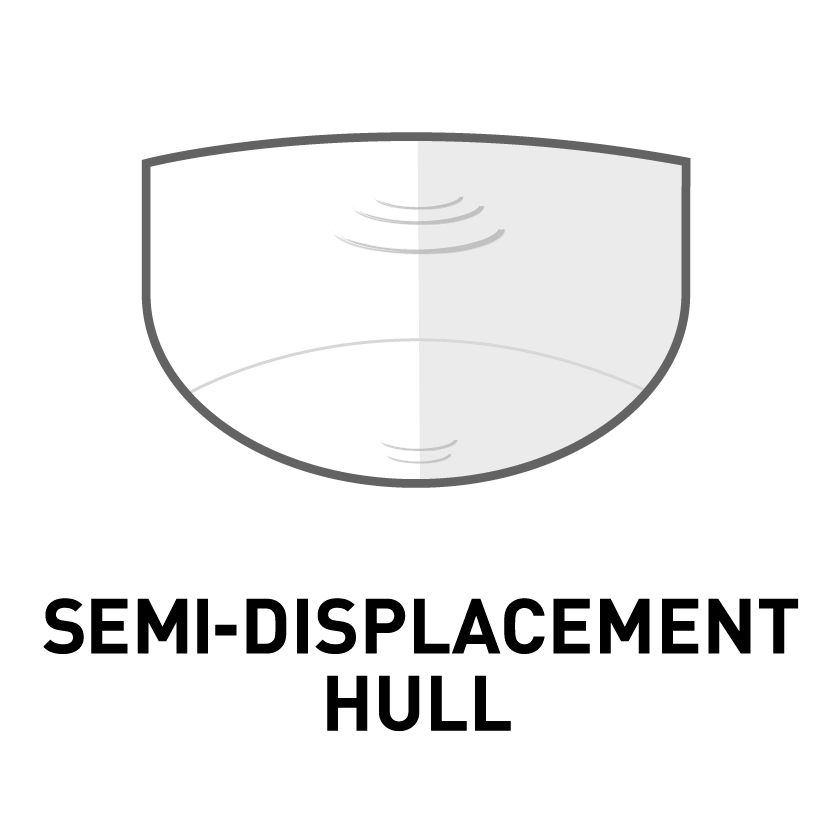
A semi-displacement hull combines the low-speed efficiency of a displacement hull with the lift and improved speed of a planing hull. The semi-displacement hulls are a hybrid of both displacement and planing hulls. These hulls displace water at low speeds, but they can lift when at a cruising speed. Typically, these hulls are faster than displacement hulls and more stable than a planing hull. Examples of boats with this hull include motor cruisers and trawlers.


Other Factors Affecting Boat Stability
Several structural features — such as deadrise, keel, beam, draft, and freeboard — work together with the hull to determine how steady, safe, and predictable a boat feels on the water.
The hull needs the help of other parts of a boat. Think of it as an orchestra - you need the strings, woodwinds, and percussion for an orchestra to be complete. The same is true for a boat.
Let’s look at the five key parts of a boat. For an exhaustive list, check out our complete guide to boat parts.
1. Deadrise
Deadrise is the angle of the hull bottom, and it directly affects how smoothly a boat rides through waves and how stable it feels in different water conditions.
Deadrise is an important measurement related to the boat's stability. It is the angle measurement between the bottom of the vessel and the horizontal plane on either side of the center keel. It lets boaters know how well the boat rides.
You will find the keel that runs in the middle of the boat from bow to stern. It is a structural beam whose purpose is to keep the ship stable and in control while moving forward.
For example, the deadrise is zero on a flat-bottomed boat, and on a deep v-hull, the deadrise can be as high as 20 degrees or higher.


2. Keel
The keel is the long, flat blade that goes down into the water from the bottom of the boat. The keel provides counterbalance to the boat, which controls it from being blown sideways in high winds.


3. Beam
A boat’s beam, or its width at the widest point, influences how stable it feels, how much interior space it offers, and how it performs in rough or calm water.
The beam is an important part of a boat because it, too, determines the boat's degree of stability on the water. The beam is the width of a ship at its widest part of the waterline. Its formal name is "beam overall" or BOA. To correctly measure the beam of a boat, measure the widest part from the port (left side) to the starboard (right side).
A boat with a narrow beam can go faster than a boat with a wider beam. Yet, a narrow beam does not handle heavy waves.
A wider beam handles rough and choppy water but cannot go as fast since it must displace more water as it moves forward.
4. Draft
Draft is simply the distance between the boat’s keel and the waterline. It is determined by how deep the boat sits in the water. Boats either have a shallow or deep draft.
A boat with a shallow draft can easily navigate in calm and shallow waters, such as a fishing boat, as it easily glides and will not take on any damage from snagging rocks or debris. Shallow draft boats cannot handle rough conditions and are very unstable.
Boats with a deep draft perform well in choppy and wavy waters and are considered seaworthy. Deep draft boats do not do well in inland waters.
5. Freeboard
Freeboard is the distance from the waterline to the lowest point on your boat’s deck, also known as the gunwales. The freeboard’s measurement is significant to know when operating your boat on certain waters for safety reasons.
If you are boating on bigger lakes or in saltwater, both bodies of water have sizeable waves; and if your boat's freeboard is low, this could be dangerous. The waves could wash over the deck, and your ship could take on water and sink.


An Overview of Hull Shapes
Different hull shapes — flat, round, multi-hull, and V-shaped — are built to optimize performance for specific water conditions, speeds, and boating activities.
There are many shapes of hulls. Today, more than ever, boatbuilders are expertly engineering and crafting various hulls to offer their customers top-performing boats. They are creatively combining different types of boat hulls in their designs to elevate the boater’s experience.
To make this simple, we are breaking the shapes of hulls down into four designs. These shapes are aligned with a specific hull category.
Flat-Bottomed Hulls
Flat-bottomed hulls fall into the planing category. Flat-bottomed boats are ideal for use in shallow water and are extremely popular among anglers who fish in inland freshwater. This hull shape offers a stable ride on calm water, and because they quickly get on plane, they perform well at higher speeds. Flat-bottom hulls do not do well in choppy or rough waters, and you would not use them in the ocean.
Let’s look at the flat-bottomed hull pros:
- Shallow draft can navigate shallow rivers, lakes, and ponds
- This hull sits on the water, giving it excellent stability
- Easily slide over any obstacles in the water
Let’s look at the flat-bottomed hull cons:
- Don’t perform well in rough waters
- Designed for freshwater only
- Not a versatile hull


Round-Bottomed Hulls
Round-bottomed hulls fall into the displacement hull category. They offer a soft ride but are not as stable as a flat-bottomed boat and tend to rock back and forth. Examples of round-bottom hull shapes are canoes and sailboats.
Let’s look at the round-bottomed hull pros:
- The rounded shape allows easy travel through the water at slower speeds
- Restricts the quantity of drag on the boat
Let’s look at the round-bottomed hull cons:
- Can be very unstable and can roll and even without a deep keel


Multi-Hulls
Multi-hulls are in the displacement and planing hull categories, and you will find them on pontoon boats, sailboats, and power catamarans. As the name suggests, this shape has more than one hull and offers more stability.
Let’s look at the multi-hull pros:
- Stability because of its wide beam
- Multi-hulls can be up to 30% faster than monohulls
- Creates more space on the boat
Let’s look at the multi-hull cons:
- Large turning radius requiring a bigger area
- Not all are designed for saltwater, such as pontoon boats
- Propellers on planing multi-hulls offer holding ability and higher pitch


V-Shaped Hulls
V-shaped hulls, a common speed boat hull design, are in the planing category and are the most popular hull shape, especially in the recreational boat arena. Examples of V hulls are powerboats and fiberglass motorboats.
Let’s look at the V-shaped hull pros:
- Smooth ride at higher speeds
- Performs well in choppy or rough waters
- Ideal for inland and offshore
Let’s look at the V-shaped hull cons:
- Can roll or bank when making sharp turns
- More power to go at higher speeds (not fuel-efficient)
- Require larger engine(s)


You now know the basics about hulls and what to consider when you’re buying a boat. Understanding these concepts will help you make the best decision for the type of boat you need.
A Few Modern Hull Innovations You Should Know About
Boatbuilders continue evolving hull technology to boost performance:
- Stepped Hulls
Steps in the hull introduce air under the running surface, reducing drag and increasing speed. - Hybrid Hulls
These blend flat, V, and rounded sections to improve versatility in mixed conditions. - Tunnel Hulls
Used in shallow-water boats to elevate the propeller and reduce draft. - Surf Hulls (Tow Boats)
Designed to shape water displacement and create large, surfable wakes.


How Boat Hull Design Affects Ride Quality, Fuel Efficiency, & Handling
A boat’s hull design shapes how smooth the ride feels, how much power it needs, how efficiently it uses fuel, and how well it handles turns and waves. Most boat shoppers focus on length, engine size, or layout — but your hull impacts more of your boating experience than any other feature. The hull determines:
- How smooth the ride feels in waves
- How stable the boat sits at rest or while moving
- How quickly the boat gets on plane
- How fuel-efficient your trips will be
- How well the boat handles turns, acceleration, and deceleration
For instance, a deep-V hull cuts through chop but requires more horsepower and fuel. A flat-bottom hull is stable at rest but uncomfortable in rough water. Multi-hulls maximize deck space and stability, but their turning radius is wider. Knowing how these characteristics play together helps you choose a boat that matches your environment and boating style.
How Water Conditions Influence the Best Hull Choice
The best hull for your boat depends heavily on where you operate — shallow rivers, large lakes, or ocean waters each require different hull shapes to perform safely and comfortably.
When choosing a hull type, the body of water you primarily boat on is one of the most important considerations:
Calm Inland Lakes & Shallow Rivers
- Flat-bottom hulls
- Modified-V hulls
- Jon boats
These hulls sit higher, draft less water, and feel stable when fishing or anchored.
Large Lakes & Coastal Bays
- Deep-V hulls
- Multi-hull pontoon-style layouts
- Semi-displacement cruisers
These handle chop better and offer safer, more predictable performance.
Offshore, Ocean, or Open-Water Conditions
- Deep-V hulls
- Catamarans
- Full displacement trawlers
These options manage big swells and rolling waves more effectively and track straighter in crosswinds.
Matching hull type to water type dramatically improves both safety and comfort.
The Role of Hull Materials & How They Impact Performance
Beyond shape, the hull material affects durability, weight, and ride feel.
Fiberglass
- Most common in recreational powerboats
- Smooth ride and strong impact resistance
- Allows for complex V-shaped hull designs
Aluminum
- Lightweight and highly durable
- Ideal for shallow-water and fishing boats
- Often paired with flat-bottom or modified-V hulls
Wood
- Traditional and visually appealing
- Expensive to maintain
- Mostly found in classic or custom vessels
Composite Hulls
- Increasingly popular for strength and reduced weight
- Often used in high-performance or offshore vessels
Materials determine how the hull reacts to impacts, weight distribution, and long-term maintenance—key considerations that affect ownership costs.


How to Choose the Right Hull for Your Boating Lifestyle
The right hull for your boating lifestyle depends on how and where you use your boat, with shallow‑water anglers needing flat or modified‑V hulls, speed and watersports boaters benefiting from planing V‑hulls, long‑range cruisers choosing displacement hulls, families preferring stable multi‑hulls, and ocean boaters relying on deep‑V, catamaran, or semi‑displacement designs built for rough water.
Instead of choosing by shape alone, think function-first:
- If you enjoy fishing in shallow waters:
Choose a flat-bottom or modified‑V hull. - If you prioritize speed and watersports:
Go with a planing V‑hull. - If you take long-distance cruises:
A displacement hull with a deeper draft delivers the best efficiency. - If you want stability for family outings:
A multi-hull pontoon or catamaran maximizes level riding and deck space. - If you boat on the ocean:
Look for deep-V, catamaran, or semi‑displacement designs engineered for rough water.
Frequently Asked Questions about Boat Hulls
- What is a boat hull?
A boat hull is its outer body and gives the boat its shape and is designed to keep water out. Hulls are made of fiberglass, wood, or metal. - What type of planning handles rough water the best?
For those boaters who are adventure seekers and love to go fast, especially in choppy water, V-shaped planing hulls perform the best in these conditions. The deeper the V-shape, the better the boat, typically powerboats, can handle rough water since it is a wedge shape from stem to stern and cuts through the water. - What is the fastest boat hull design?
This could be an entire blog! We will offer you the simple answer. Going fast in a boat depends on the conditions. The v-hull design performs well as far as speed is concerned in choppy waters such as the ocean. If you prefer calmer waters such as an inland lake or river, flat-bottom hulls can operate at higher speeds. - What type of boat has a planing hull?
Planing hulls are designed to rise up and skim on top of the water at high speeds. Boats that have a planing hull include:
- Powerboats
- Personal watercraft (PWC)
- Some smaller sailboats -
What are the main differences between displacement, planing, and semi-displacement hulls?
Displacement hulls move through the water by pushing it aside, planing hulls rise up and skim on top of the water at speed, and semi‑displacement hulls combine characteristics of both. Displacement hulls are slower but stable, planing hulls are fast but require power, and semi‑displacement hulls offer a balanced mix of speed and stability. -
How do I know which boat hull type is right for the way I plan to use my boat?
The best hull type depends on where you boat and how you want your boat to perform.
- Choose a displacement hull for cruising and fuel‑efficient travel.
- Choose a planing hull for speed and watersports.
- Choose a semi-displacement hull for mixed conditions.
Your typical water conditions — shallow, deep, calm, or rough — should guide your decision. -
Which hull shape handles rough water the best?
Deep V-shaped hulls handle rough water the best because their sharper angle cuts through waves and reduces pounding. This design helps maintain stability and rider comfort in choppy or offshore conditions. -
Why does hull shape matter when buying a boat?
Hull shape determines stability, handling, speed, fuel efficiency, draft depth, and overall ride quality. The right hull ensures your boat can safely and comfortably handle the waters you plan to explore. -
What is deadrise, and why is it important?
Deadrise is the angle between the bottom of the hull and a horizontal plane. A higher deadrise (like on deep‑V hulls) improves performance in rough water, while a lower deadrise offers better stability on calm water. -
What type of hull is best for shallow water boating?
Flat‑bottom hulls and other shallow‑draft hull designs are best for shallow water. They sit high in the water, making it easier to navigate rivers, ponds, sandbars, and flats without hitting bottom. -
Which hull type is most fuel-efficient?
Displacement hulls are typically the most fuel‑efficient because they move steadily through the water and require less horsepower to maintain speed. They are ideal for long-distance cruising. -
What boat hull shape is the most stable?
Multi-hull designs — such as pontoons and catamarans — are often the most stable thanks to their wide beam and multiple flotation points. They minimize side‑to‑side rocking and offer a very level ride. -
Do V-shaped hulls work well for beginner boaters?
Yes. V-shaped hulls are versatile and handle a wide range of water conditions. They offer predictable handling and smoother performance in waves, which many first‑time boaters appreciate. -
What is the advantage of a flat-bottom hull vs. a V-hull?
Flat-bottom hulls are ideal for calm, shallow water and offer excellent initial stability. V‑hulls, however, perform better at higher speeds and handle rough water more effectively. -
Can you use a flat-bottom boat in the ocean?
Flat-bottom hulls are not recommended for ocean use. They perform poorly in choppy or unpredictable conditions and are designed primarily for calm inland waters. -
What hull type provides the smoothest ride?
Deep V-shaped hulls generally provide the smoothest ride because their angled design cuts through waves instead of slapping against them. This reduces impact and increases overall comfort for passengers. -
Are multi-hull boats faster than monohull boats?
Often, yes. Multi-hulls like power catamarans can be up to 30% faster than monohulls of similar size thanks to reduced drag and improved hydrodynamics. This varies by design and engine setup. -
Which hull type is best for fishing?
It depends on the environment:
- Flat-bottom hulls are great for shallow freshwater fishing.
- Multi-hulls (like pontoons) offer stable platforms for family and leisure fishing.
- V-hulls excel in choppier lakes or coastal waters. -
What does boat draft mean, and how does it affect performance?
Draft is the distance between the waterline and the boat’s lowest point (usually the keel). A shallow draft allows access to skinny water, while a deeper draft improves stability and performance in rough water. -
How does beam width affect boat stability?
A wider beam increases lateral stability and reduces rolling. Narrower beams provide better speed and efficiency but can feel less stable in waves. -
What type of hull do pontoon boats have?
Pontoon boats use a multi‑hull design, typically with two or three aluminum tubes that provide excellent stability, large deck space, and comfortable cruising characteristics. -
Why do some hulls rock more than others?
Round‑bottom hulls and narrow-beam boats tend to rock more because their shape reduces initial stability. Boats with flat bottoms or wide beams resist side‑to‑side rolling better. -
What hull type is best for long-distance cruising?
Displacement hulls are ideal for long-distance cruising because they move efficiently at slower speeds and offer excellent stability, even under heavy loads. -
What is a keel, and how does it help with stability?
The keel is a structural backbone running along the bottom of the boat. It improves tracking, reduces sideways drift in wind, and enhances overall stability during forward motion.
-
What is a boat hull?
A boat hull is its outer body and gives the boat its shape and is designed to keep water out. Hulls are made of fiberglass, wood, or metal.